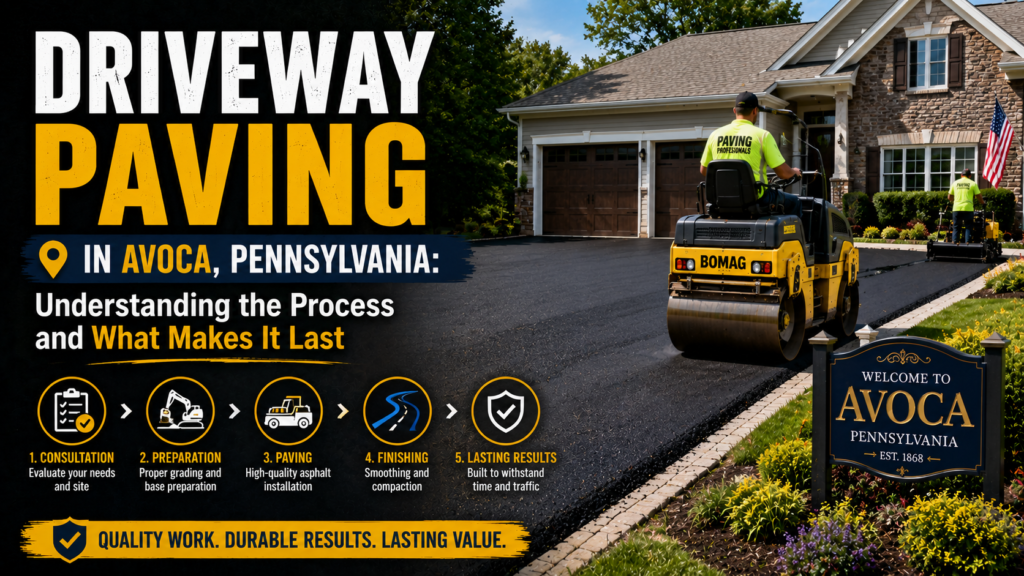
A paved driveway is one of the most used and most visible features of any residential or small commercial property in Avoca, Pennsylvania. It receives daily vehicle traffic, endures seasons of freeze-thaw cycling, absorbs UV radiation, and stands up to the weight of delivery trucks, plows, and salt. When it is built correctly, a paved driveway performs reliably and attractively for twenty years or more. When it is built incorrectly with inadequate base preparation, poor drainage, or substandard materials problems emerge quickly and require ongoing intervention. Understanding what goes into quality Driveway Paving Avoca helps property owners recognize good work and avoid costly mistakes.
Asphalt: The Dominant Driveway Material in Avoca
In Avoca and across Lackawanna and Luzerne Counties, asphalt is the material of choice for residential driveways. This preference is driven by practical performance in the region’s climate. Pennsylvania’s freeze-thaw cycles create seasonal ground movement that cracks rigid pavement materials. Asphalt’s inherent flexibility allows it to accommodate minor movement without breaking, and its lower initial installation cost compared to concrete makes it economically attractive for residential applications.
Asphalt also has the advantage of speed a newly paved asphalt driveway in Avoca is typically ready for vehicle use within 24 to 48 hours of installation, unlike concrete which requires extended curing periods. And when asphalt does eventually require repair, the repair materials blend with the original surface far more seamlessly than concrete patching.
Site Assessment: The First and Most Important Step
Before any paving material is ordered or any equipment brought to the site, a thorough assessment of the driveway area is essential. Key assessment questions include:
- What is the existing surface and base condition? Paving over an existing driveway (overlay) is appropriate only if the current base is structurally sound. If soft spots, drainage problems, or base failure exist, they must be addressed before any new surface is applied.
- What are the drainage conditions? The driveway must slope away from the home and toward appropriate drainage outlets. Any topographic conditions that would cause water to pond on or near the driveway need to be addressed during site preparation.
- What are the edge conditions? Driveways that lack defined edging tend to crack along the edges as the asphalt overhangs unsupported ground. Edge conditions should be addressed as part of the paving scope.
- Are there underground utilities that need to be located? Pennsylvania One Call (811) notification is required before any excavation begins.
Excavation and Sub-Base: What Happens Below the Surface
The durability of a paved driveway in Avoca is determined primarily by what happens below the surface during installation. The excavation and sub-base phases are where the foundation of the entire pavement system is established:
- Excavation: Existing material is removed to the required depth typically 8 to 10 inches for a residential driveway. The sub-grade (the native soil beneath) is shaped to the required grade and compacted.
- Drainage management: Any soft spots in the sub-grade are addressed with appropriate fill or drainage corrections before base material is placed.
- Aggregate base installation: A layer of compacted quarry process stone typically 4 to 6 inches deep is spread and compacted in layers. This base layer distributes vehicle loads, provides internal drainage, and prevents frost heave from reaching the asphalt surface.
Shortcuts in base preparation are the most common cause of premature driveway failure in Northeastern Pennsylvania. A base that is too thin, improperly compacted, or installed over inadequate sub-grade will eventually fail under traffic loads and frost cycling, producing cracks, potholes, and settlement that cannot be corrected by surface treatments alone.
The Paving Phase
Once the base is prepared, the asphalt paving phase proceeds:
- Hot mix asphalt delivery: Fresh hot mix asphalt is delivered from the plant in insulated trucks. The material must maintain appropriate temperature typically above 275 degrees Fahrenheit for proper placement and compaction.
- Paving: The asphalt is spread to a uniform depth using a mechanical paver or, for smaller driveways, by hand in confined areas. A residential driveway typically receives 2 to 3 inches of compacted asphalt surface course.
- Compaction: Steel drum rollers compact the fresh asphalt while it is still at temperature. Compaction reduces air voids, increases density, and creates the smooth, durable surface characteristic of quality pavement.
- Edging and finishing: Driveway edges are compacted and shaped to provide clean, stable borders.
Post-Paving Care in Avoca’s Climate
New asphalt in Avoca requires some specific care during the first season to achieve its design performance. The asphalt binder continues to cure and harden after installation, reaching full stability over the first 6 to 12 months. During this initial curing period:
- Avoid driving heavy vehicles on the new surface during hot summer weather, when asphalt softens.
- Avoid turning vehicle steering wheels while the vehicle is stationary on the surface the stress point loading this creates can leave marks in new asphalt.
- Keep petroleum products (oil, gasoline, power steering fluid) off the surface they degrade asphalt binder.
After approximately 6 to 12 months, the first sealcoat application should be applied to protect the cured surface from UV oxidation and moisture infiltration through the first Avoca winter.
Conclusion
Driveway paving in Avoca is a substantial investment that deserves careful planning and execution. The combination of proper site assessment, thorough sub-base preparation, quality asphalt materials, correct installation technique, and appropriate post-installation care determines whether a paved driveway in Northeastern Pennsylvania’s demanding climate lasts two decades or requires repeated attention within a few years. Understanding the process at this level of detail is the best tool any property owner has for evaluating contractor proposals and recognizing quality work.